If you’ve been told your home needs subterranean termite protection, you’ve probably run into two very different treatment approaches: liquid termiticide and termite baiting systems. Both work — but they work in different ways, on different timelines, and at different price points. Knowing the difference helps you make a confident decision instead of just picking whichever option sounds more familiar.
At Bill’s Home Service, we’ve provided subterranean termite treatment in Tucson and surrounding communities, including Green Valley and Sahuarita since 1964. We don’t push one method over the other by default — we look at your home’s construction, soil, and termite pressure, then recommend what actually fits. Here’s how the two methods compare.
How Liquid Termiticide Works
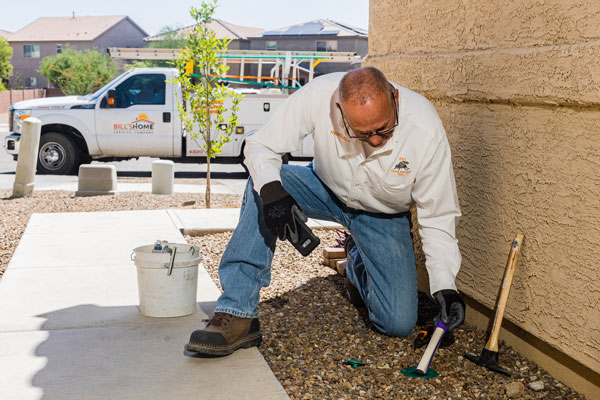
Liquid termiticide treatment creates a continuous chemical barrier in the soil around and beneath your home. Technicians trench and treat the soil along the foundation — and in some cases drill through slabs — so that any termite attempting to tunnel through to reach the structure contacts the treated zone.
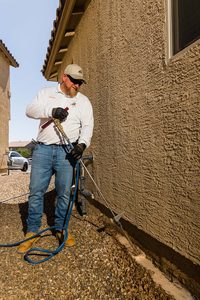
Modern non-repellent termiticides don’t just block termites; worker termites pick up the chemical and unknowingly carry it back to the colony, spreading the effect to other members through contact and grooming.
Strengths:
- Creates an immediate barrier — protection starts as soon as application is complete
- Well-suited for homes with an existing, established termite presence
- Typically a single, more contained service visit rather than ongoing monitoring
Trade-offs:
- Requires trenching around the entire foundation, which can involve digging near landscaping, patios, or hardscape
- Slab homes may need drilling through interior or exterior concrete
- Doesn’t address the termite colony directly — it’s a barrier, not necessarily elimination
- Product effectiveness tend to diminish after about a year
For a closer look at the process, learn what to expect from a termite treatment.
How Termite Baiting Systems Work
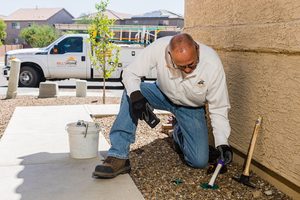
A baiting system, like the Sentricon® System with Always Active™ Technology, uses a series of stations installed in the soil around your home’s perimeter. Each station contains a cellulose material termites prefer, treated with a slow-acting substance. Foraging termites feed on the bait and share it with the colony, gradually reducing the population at its source.
Strengths:
- Minimally invasive — no trenching or drilling required
- Targets the colony itself rather than just blocking entry
- Good fit for properties where trenching is difficult (extensive hardscape, pools, mature landscaping)
- Long-term, proactive protection with ongoing monitoring and servicing
Trade-offs:
- Slower-acting — colony reduction happens over weeks to months, not immediately
- Requires regular technician visits to monitor and service stations
So Which Treatment Is Right for Your Home?
There’s no universal answer — it depends on your specific situation:
- Active termite activity right now? Liquid termiticide often makes sense for immediate barrier protection, especially if an active infestation has been observed.
- Extensive landscaping, hardscape, or a pool that make trenching impractical? A baiting system avoids the disruption while still providing solid long-term protection.
- Want ongoing visibility into termite pressure around your property? Bait stations double as a monitoring system, which some homeowners prefer for peace of mind.
- Prefer an ongoing proactive approach? Bait systems provide an ongoing, proactive approach because the products don’t break down in the soil, but continually provide protection as long as they’re being services by a professional.
In many Tucson-area homes, we also see situations where a combination approach — liquid treatment at high-risk points plus monitoring stations elsewhere — offers the best of both.
Why This Decision Matters in Southern Arizona
Subterranean termites are active year-round in our region, and soil conditions here can affect how each treatment performs. That’s part of why a cookie-cutter, national-franchise approach doesn’t always translate well locally. We’ve spent three generations learning how Tucson soil, construction styles, and termite behavior actually interact.
Frequently Asked Questions
Both are proven effective when applied correctly. Liquid termiticide provides an immediate barrier, while bait systems work more gradually to reduce the colony at its source. The “more effective” option depends on your home’s construction and termite activity level.
Many homes do well with bait systems alone, but some situations — especially active infestations — benefit from combining both methods for immediate protection plus long-term monitoring.
Most modern liquid termiticides say they remain effective for 5 years under ideal conditions. However, Tucson has anything but ideal conditions. In our more than 60 years of experience, we’ve found that the best products on the market tend to start breaking down after about a year due to the harsh desert conditions.
Sentricon is recognized as the industry leading termite baiting system trusted across Tucson and the United States. In addition to it’s durable bait designed to withstand the harsh southern Arizona elements so you always have termite protection in the ground around your home, it’s also the only termite control product to receive the EPA’s prestigious Presidential Green Chemistry Challenge Award.
Yes. Bait stations require periodic monitoring and servicing to remain effective, which is typically included as part of an ongoing termite protection plan.
Not Sure Which Option Fits Your Home?
That’s exactly why at Bill’s Home Service we start with a thorough inspection. We’ll evaluate your property’s construction, soil, and termite pressure, and walk you through which treatment approach makes sense — no upselling, just the right recommendation for your home.
Call us today at 520-625-2381 to schedule your termite inspection to find the right protection for your home.